The ESP32-C6 is the chip of modern home automation. Not because it is the most powerful, but because it brings something none of its siblings have: an 802.15.4 radio, the foundation of Thread, Zigbee and Matter. And on top of that, it ships Wi-Fi 6.
If you are building a genuinely connected home (one that talks to Apple Home, Google Home or Home Assistant without hacks), this is the chip.
What it is
The C6 uses two RISC-V cores: a high-performance one (HP, 160 MHz) and a low-power one (LP, 20 MHz) that can keep watching sensors while the rest sleeps.
| Thing | Value |
|---|---|
| Cores | RISC-V HP 160 MHz + LP 20 MHz |
| SRAM | 512 KB |
| Wi-Fi | Wi-Fi 6 (802.11ax, 2.4 GHz) |
| Bluetooth | BLE 5 |
| 802.15.4 | Thread / Zigbee / Matter |
| GPIOs | 30 |
| USB | native Serial/JTAG |
What makes it unique: 802.15.4 + Wi-Fi 6
- 802.15.4 is the radio behind Matter, Thread and Zigbee. Without it, your device cannot speak the language of the modern connected home.
- Wi-Fi 6 is not marketing: it plays nicer with crowded networks and adds TWT (Target Wake Time), letting the device negotiate with the router when to wake up. Translation: less power for the same Wi-Fi.
And it can use Wi-Fi and 802.15.4 at the same time, so you can build a Thread border router… or simply be a Matter device that reaches the Internet over Wi-Fi.
Pinout: the essentials
| Pin(s) | What for |
|---|---|
| GPIO12 / GPIO13 | USB D− / D+ |
| GPIO0–6 | ADC1 |
| GPIO8, GPIO9, GPIO15 | Strapping |
| GPIO24–30 | Internal flash (do not use) |
| GPIO5 / GPIO6 | usual UART (RX / TX) |
As across the family: no DAC, no touch, and ADC2 does not work with Wi-Fi (here, use ADC1).
Boards and modules
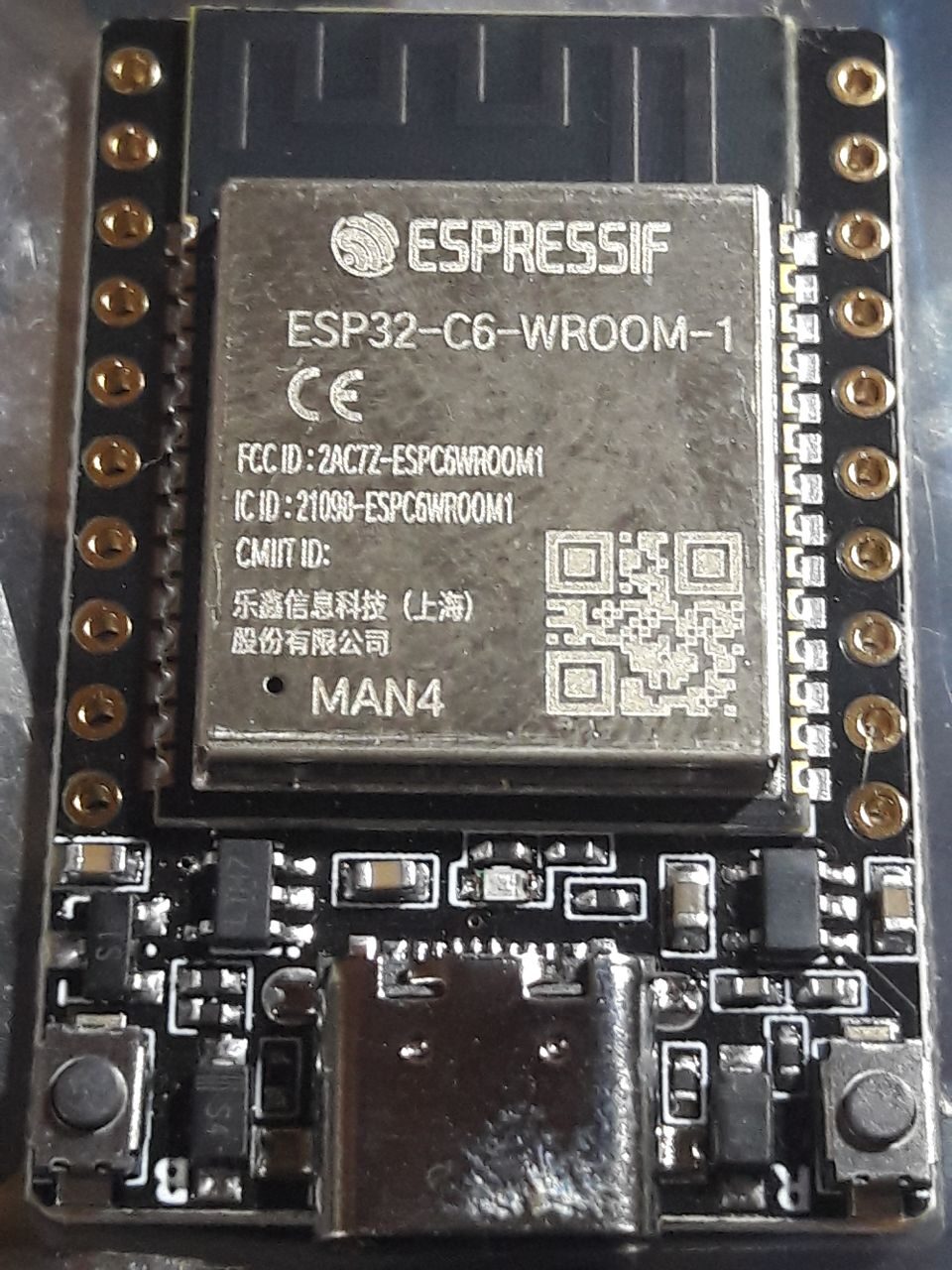
- ESP32-C6-WROOM-1 — standard module.
- ESP32-C6-MINI-1 — small version.
- ESP32-C6-DevKitC-1 — development board.
- ESP32-C6-DevKitM-1 — the reduced one.
When to pick it (and when not to)
Yes, pick the C6 if…
- You are doing Matter, Thread or Zigbee.
- You want Wi-Fi 6 and good power behaviour with TWT.
- You need a device compatible with modern home ecosystems.
- You want to build a Thread border router.
Do not pick it if…
- You only do plain, cheap Wi-Fi: a C3 costs less.
- You need camera, audio or AI: that is the S3.
- You need classic Bluetooth or a DAC: the classic.
- You do not need Wi-Fi: the H2 is cheaper for an 802.15.4/BLE node.
Typical mistakes
- Buying a C6 “to try” without a recent toolchain: Matter needs ESP-IDF 5.1+ (today we are on 6.1).
- Expecting a DAC or touch that do not exist.
- Confusing Matter (application protocol) with Thread (network): the C6 has the radio for both.
Summary
- Dual RISC-V (HP + LP), 512 KB SRAM.
- Wi-Fi 6 + BLE 5 + 802.15.4: the only one in the family with hardware Matter.
- 30 GPIOs and USB Serial/JTAG.
- It is the choice for modern home automation; for everything else, C3 or S3.
- It needs an up-to-date toolchain (ESP-IDF 5.1+, ideally 6.x).
Next step: the ESP32-H2, its Wi-Fi-less sibling for battery Matter nodes. Or go back to the series hub.